You search Korean facial near me, open a few local results, and quickly run into the same problem. One menu promises “glass skin.” Another lists a long set of add-ons without explaining what any of them do. A third looks relaxing, but you still can't tell whether the treatment is meant for dehydration, rosacea, pigmentation, …

You search Korean facial near me, open a few local results, and quickly run into the same problem. One menu promises “glass skin.” Another lists a long set of add-ons without explaining what any of them do. A third looks relaxing, but you still can't tell whether the treatment is meant for dehydration, rosacea, pigmentation, texture, or early skin laxity.
That confusion is normal. A Korean facial can be a smart starting point for healthier skin, but only if the provider treats it as a structured protocol instead of a trend label. The difference between a spa-style glow facial and a clinical Korean facial usually comes down to customization, skin analysis, and treatment sequencing.
Table of Contents
- Searching for a Korean Facial in Cincinnati
- What Is a True Korean Facial Protocol
- Benefits and Results for Your Skin Type
- How a Korean Facial Differs From Other Treatments
- Your Consultation-First Facial at Face Studio
- Explore Our Full Suite of Corrective and Wellness Services
- Frequently Asked Questions About Korean Facials
Searching for a Korean Facial in Cincinnati
A typical search starts the same way. Someone in Cincinnati notices that her skin is looking tired, congested, or reactive, types in Korean facial near me, and gets a page full of treatments that sound similar but do very different things.
That confusion is common. Search interest in Korean skincare has grown enough that major publishers now track it as a sustained beauty category rather than a passing social trend, as reported in this market review of K-beauty growth and consumer demand. The problem is that local listings often borrow the language without explaining the treatment standard behind it.
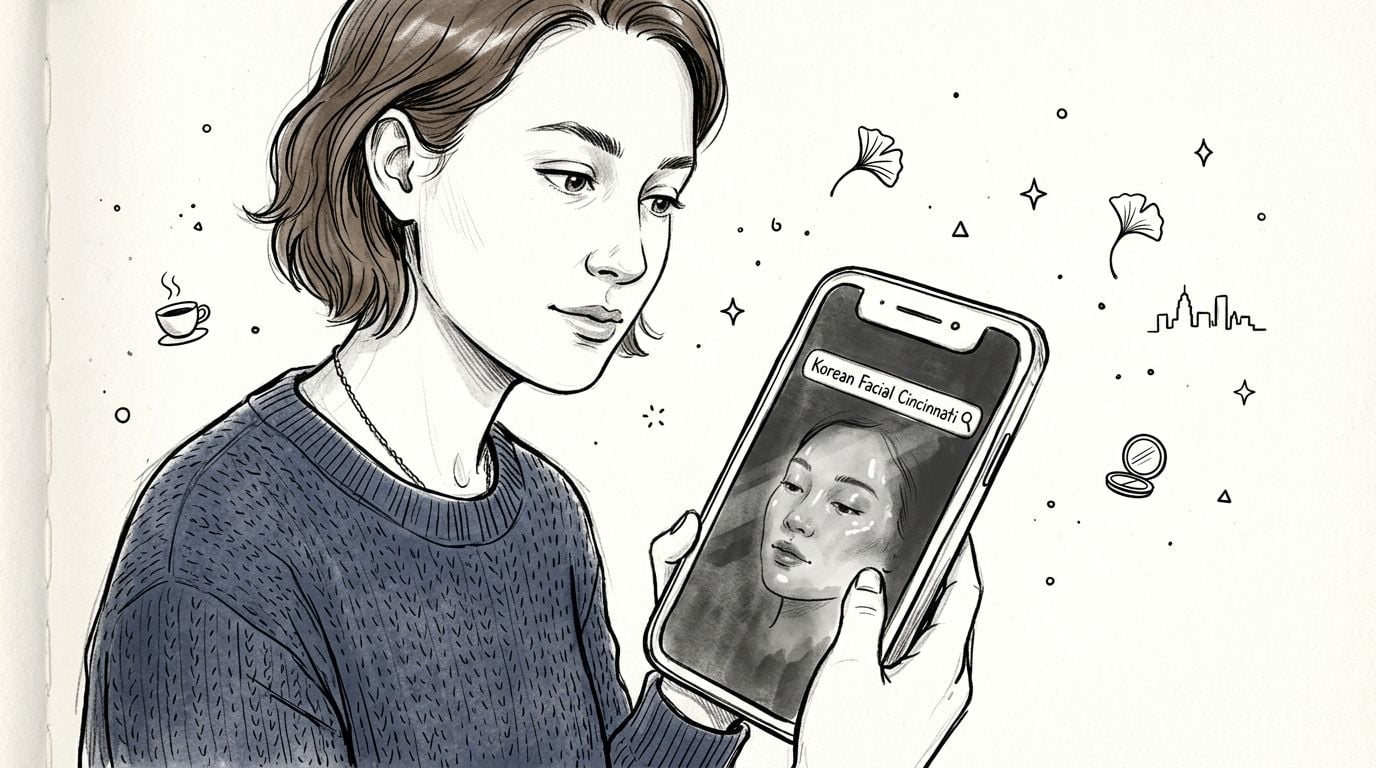
What people usually find in local search
In practice, “Korean facial” can mean a relaxing hydration service, a product-themed spa facial, or a clinical protocol built around barrier repair, congestion control, and texture refinement. Those are not interchangeable treatments.
That distinction matters because the wrong facial can waste a visit. Skin that is sensitized may need less exfoliation, not more. Skin with congestion may need careful extractions and inflammation control, not just layers of hydrating products. Pigment-prone skin often needs a slower corrective plan so the treatment improves clarity without triggering more irritation.
A useful local result should make four things clear:
- What is included. Cleansing, exfoliation choice, extractions, massage, masking, LED, and device-based steps all change the outcome.
- Who the treatment is meant for. Dry, reactive, acne-prone, and pigment-prone skin do not respond well to the same protocol.
- What the recovery looks like. Some facials leave skin calm the same day. Others require aftercare, sun protection, and spacing between visits.
- What the next step is if one facial is not enough. Corrective skin work often starts with one visit, then builds into a plan.
If you're comparing options in Cincinnati, a detailed facial treatment menu with corrective and wellness services gives you more useful information than trend language alone. It helps you match the service to the condition you want to address.
A credible provider should be able to explain why each step is being done, what it is meant to improve, and when a Korean facial is the right place to start.
What Is a True Korean Facial Protocol
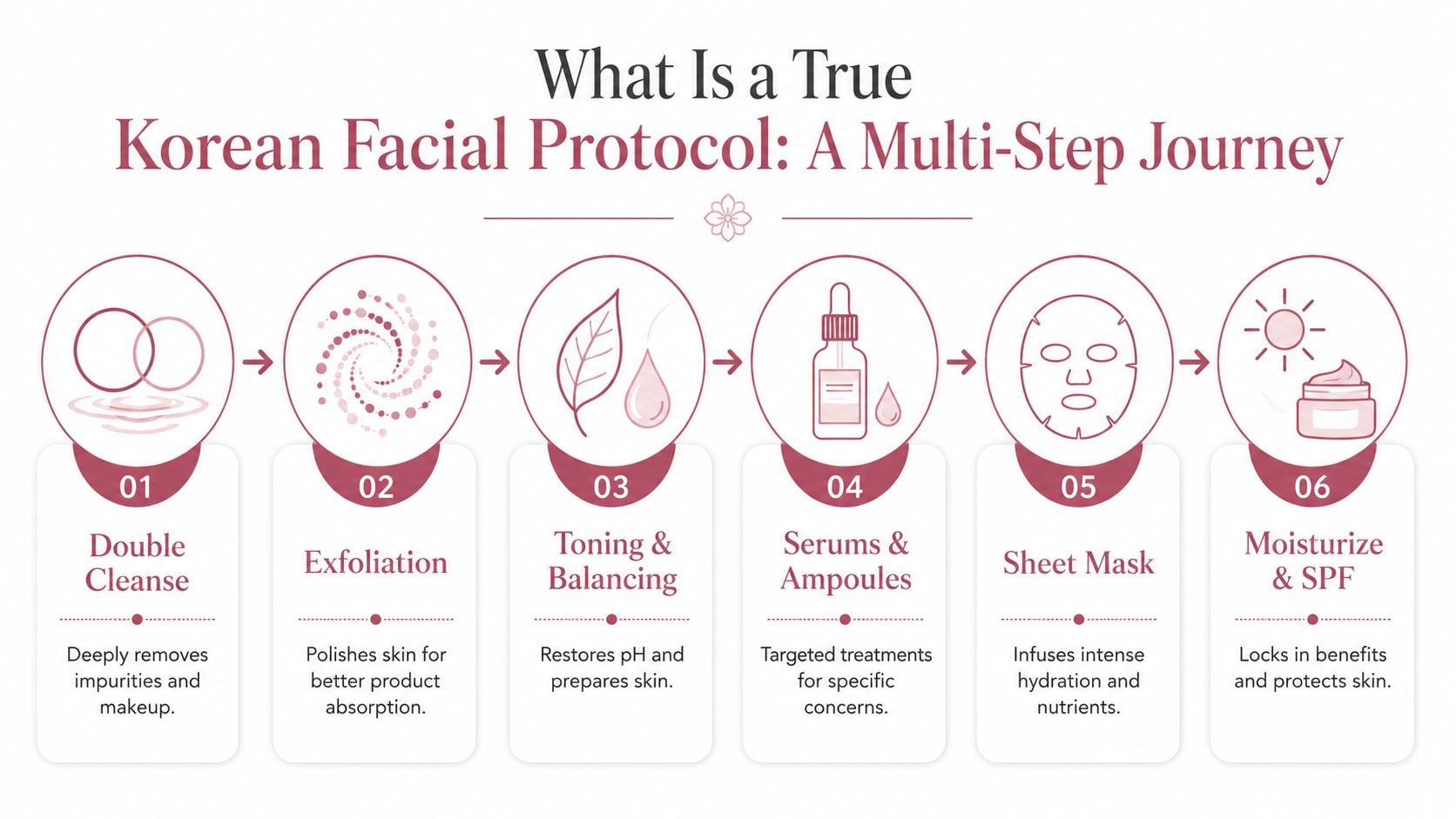
A true Korean facial isn't one hero serum or one signature mask. It's a protocol, which means several steps are layered in a deliberate order so each one supports the next. That's the part many search results leave out.
A technically credible Korean facial is described as a protocol rather than a product bundle. It commonly includes cleansing, steam, extractions, massage, targeted masking, and light therapy, with each step matched to a specific indication, as outlined in this clinical-style Korean facial service description.
Why protocol matters more than branding
The word “Korean” gets used loosely. In a clinical setting, it should signal a skin-first philosophy. The treatment builds hydration, supports the barrier, improves texture gradually, and avoids unnecessary aggression.
That doesn't mean every Korean facial is identical. It means the provider should be able to explain why each step is there.
Here's what that usually looks like in practice:
- Double cleanse to remove sunscreen, makeup, oil, and debris without stripping the skin.
- Exfoliation chosen for the actual condition of the skin. Sometimes enzyme-based, sometimes very light physical polishing, sometimes skipped.
- Steam or softening prep if congestion is present and the skin can tolerate it.
- Extractions only when needed, and only when they can be done without creating unnecessary inflammation.
- Serum or ampoule infusion matched to concerns such as dehydration, dullness, barrier weakness, post-acne marks, or loss of bounce.
- Massage and lymphatic support to reduce stagnation and improve overall skin comfort.
- Targeted mask and light therapy based on whether the goal is calming, brightening, hydration, or recovery support.
- Finishing protection so the treatment holds up once you leave.
What happens during the treatment
In a thoughtful clinical Korean facial, the provider adjusts the sequence instead of forcing every client through the same menu.
A few examples make that clearer:
- For reactive skin. The focus may stay on cleansing, barrier-supportive layering, cooling or soothing masking, and conservative light-based support.
- For congested skin. The provider may spend more time softening buildup and doing selective extractions, then follow with calming steps so the skin doesn't stay inflamed.
- For dull or mature skin. More attention may go to circulation, hydration layering, brightening actives, collagen-supportive steps, and lifting massage.
Practical rule: If a provider can't explain each step and its purpose for your skin, the treatment is probably being sold as a label, not performed as a protocol.
This is also why many clients describe it as a painless result facial. When it's done well, the treatment feels methodical, not harsh. You should leave with skin that looks more balanced and supported, not overworked.
Benefits and Results for Your Skin Type
The visible appeal of a Korean facial is easy to understand. Skin looks fresher, smoother, and more reflective. The more important benefit is less flashy. The protocol often supports the skin in ways that make it behave better between appointments.

For dry, reactive, or barrier-impaired skin
When skin feels tight, flushes easily, or becomes irritated by active products, a gentle Korean protocol can be useful because it prioritizes layered hydration and conservative correction.
That matters for people searching for a rosacea facial or support for sensitized skin. Aggressive exfoliation may briefly smooth the surface, but it often leaves a reactive barrier even more unstable. A better approach is one that restores comfort first, then introduces stronger correction only if the skin can handle it.
Common advantages for this skin type include:
- Barrier support that helps reduce the cycle of dryness, sting, and rebound irritation.
- Hydration layering that improves softness and makes skin look less crepey or fatigued.
- Reduced visible stress because the skin isn't being pushed past its tolerance.
For dullness, uneven tone, and early aging
For clients interested in a brightening facial or anti aging facial, the value of this treatment is cumulative. Better hydration changes how light reflects off the skin. Better barrier function also makes the skin more resilient, which improves how it responds to home care and future in-office treatments.
A Korean facial can help with concerns such as:
| Concern | What the protocol can help improve |
|---|---|
| Dullness | Surface smoothness, hydration, and overall radiance |
| Uneven tone | A more refined look through gentle brightening and less irritation |
| Early fine lines | A plumper appearance from hydration and better skin comfort |
| Mild post-acne marks | Supportive care that calms skin while preparing it for stronger correction if needed |
Not every skin concern needs a stronger treatment first. A lot of skin looks “aged” when it's actually dehydrated, inflamed, or chronically over-exfoliated.
What it doesn't do is replace every corrective treatment. If your main concern is deep acne scarring, significant laxity, or stubborn pigment, this protocol may be the foundation rather than the finish line.
How a Korean Facial Differs From Other Treatments
A client comes in asking for a “Korean facial,” but what she usually wants is not a trend. She wants skin that feels calmer, looks clearer, and can tolerate the next right step without flaring. That is the difference between a clinical Korean facial and many other treatments on a facial menu.
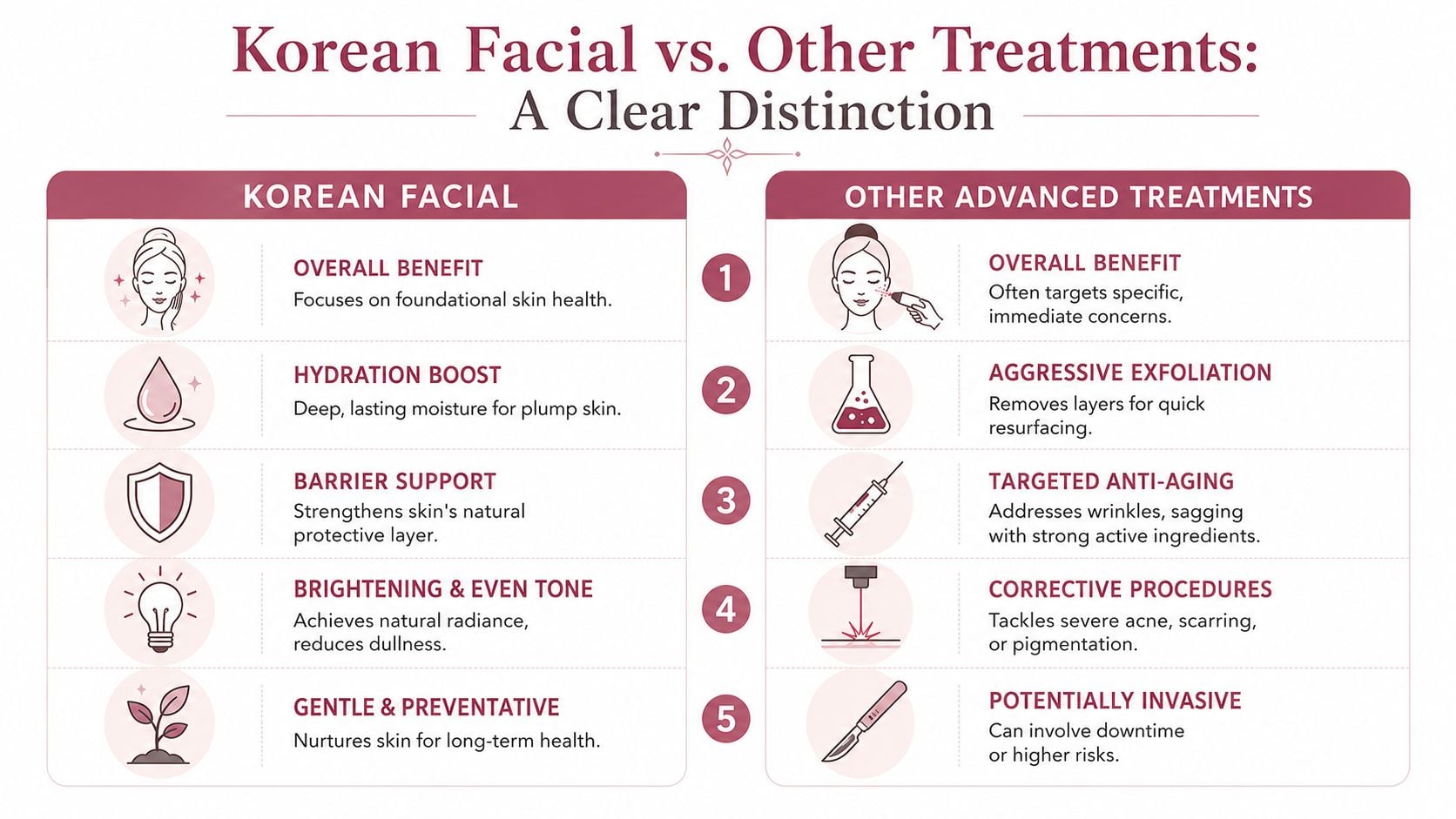
A true Korean facial protocol is not defined by one device or one massage technique. It is defined by sequencing. The treatment is built to assess the skin first, prepare it carefully, support circulation and hydration, and adjust intensity based on what the barrier can handle that day. Standard spa facials often focus on relaxation or surface glow. Corrective procedures such as microneedling, radiofrequency, or stronger resurfacing focus on creating a controlled injury so the skin remodels. Both have value. They do different jobs.
When a Korean facial is the right first step
I recommend this type of treatment when skin function is the limiting factor. In practical terms, that means the skin is reactive, depleted, congested in a delicate way, or not yet ready for a more aggressive service.
A Korean facial is often a good starting point for:
- Dehydration and barrier disruption. Skin feels tight, rough, easily irritated, or inconsistent from week to week.
- Mild congestion with sensitivity. Pores need attention, but the skin does not have the resilience for aggressive exfoliation or heavy extraction work.
- Early texture change. Skin has lost some smoothness or bounce, but the concern does not yet call for a procedure with more downtime.
- Maintenance between corrective treatments. The goal is to keep skin settled, hydrated, and responsive rather than repeatedly pushing intensity.
This category can overlap with terms like collagen facial, glass skin facial, brightening facial, or noninvasive lifting facial. The label matters less than the method. Good work supports the barrier, respects inflammation, and matches the treatment to the condition in front of you.
When another treatment is the better tool
Some concerns need more than support. They need a treatment that changes structure.
Indented acne scars usually require a modality that stimulates deeper remodeling. Visible laxity or loss of contour usually responds better to a tightening-focused plan. Stubborn pigment or heavier sun damage may call for a more exfoliation-driven service, such as a chemical peel treatment in Cincinnati, if the barrier is strong enough to handle it.
Here is the trade-off:
| Treatment type | Better suited for | Trade-off |
|---|---|---|
| Korean facial | Barrier support, hydration, brightness, mild congestion | Results are progressive and usually subtler at first |
| Liquid microneedling | Select clients who want resurfacing support without traditional needles | Can improve feel and appearance, but does not replace classic microneedling |
| Traditional microneedling | Acne scars, texture irregularity, collagen stimulation | More corrective, with more healing time and stricter aftercare |
| Tightening-focused treatments | Firmness, contour changes, mild laxity | Better for structural concerns than dehydration-driven dullness |
| Chemical peel | Pigment, rough texture, visible photodamage | More intensive and not appropriate for every compromised barrier |
Clients often confuse a Korean facial with a peel because both can leave skin looking brighter. The mechanism is different. A peel relies primarily on controlled exfoliation. A clinical Korean facial uses preparation, circulation support, hydration layering, selective exfoliation, and calming steps to improve how the skin functions. That difference matters, especially for skin that is inflamed, over-exfoliated, or stuck in a cycle of chasing results with treatments it cannot recover from well.
The strongest treatment is not the goal. Productive treatment is.
Your Consultation-First Facial at Face Studio
A client searches "korean facial near me" after a week of tight, dull, reactive skin. She often expects a long menu of trendy steps. What she usually needs first is a careful read of barrier function, inflammation level, treatment history, and timing. That is the difference between a clinical Korean facial and a spa-style version that follows the same order for everyone.
What a first visit should include
A proper intake does more than ask which cleanser you use. It should identify what changed, how long it has been happening, what the skin is reacting to, and what it has already been through. In practice, that means looking at dryness, congestion, redness, pigment, breakouts, sensitivity, and textural change in context, not as isolated complaints.
At Face Studio and Wellness Center, the Korean facial sits inside a consultation-led model. The goal is to choose the right starting point, not force every client into the same glow-focused service. Some clients are ready for hydration layering and circulation support. Others need calming care first, or a broader plan built from corrective skin treatment options once the skin is stable enough to tolerate more.
A useful consultation usually covers:
- Current skin behavior. Tightness by midday, flushing after cleansing, recurring congestion, rough patches, or post-breakout marks all point to different treatment choices.
- Recent treatment history. Retinoids, acids, injectables, laser sessions, waxing, and aggressive scrubs can change what is safe that day.
- Actual treatment goals. "Brighter" may mean less redness, better hydration, smoother texture, or help with uneven pigment.
- Recovery window. Some clients need low-disruption care before an event or workweek. Others are comfortable following a staged corrective plan.
What makes the clinical approach safer
Safety comes from selection and restraint. A true clinical protocol adjusts the steps to the skin in front of you.
That may mean no steam for a client who flushes easily. It may mean postponing extractions when acne is inflamed and tender. It may mean reducing exfoliation and spending more time on hydration, cooling, and barrier repair. It may also mean saying that the service someone requested is not the right first appointment.
Overtreated skin can look polished for a day and become more reactive afterward. I see this most often in clients who have been rotating actives, chasing brightness, and confusing stimulation with progress. Good treatment planning lowers that cycle. Diagnosis comes first, then sequencing, then visible results that the skin can maintain.
Explore Our Full Suite of Corrective and Wellness Services
A Korean facial is often the entry point, not the whole plan. Once the skin is calmer, better hydrated, and easier to read, treatment options open up in a more productive way.
Skin correction and lifting services
Some clients need foundational care. Others need a more direct corrective strategy. That's where a broader category of skin correction and regeneration treatments becomes useful.
That group can include services such as:
- Noninvasive lifting and tightening for clients who want firmer contours without surgery.
- Collagen facials and anti-aging facials for support around texture, bounce, and early laxity.
- Microneedling and RF with microneedling for structured collagen stimulation and acne scarring treatment planning.
- Liquid microneedling for clients who want a gentler resurfacing path.
- Hyperpigmentation and skin damage facials for uneven tone and sun-related change.
- PDRN facials, peptide peels, and fusion plasma options when the skin needs a regenerative approach.
- Dermaplaning additions when surface buildup or peach fuzz is interfering with smoothness and product penetration.
- Warm plasma tightening and plasma treatments when the goal shifts toward visible tightening support.
Scalp, hair, and wellness support
Corrective skin work often overlaps with overall wellness. Clients looking for more complete support may also want:
- Headspa scalp facials and scalp treatments for buildup, dryness, and scalp comfort.
- Plasma-based hair thinning treatments and other painless approaches designed to stimulate regrowth.
- Salt room services for relaxation and recovery support.
- Massage treatments for circulation, tension relief, and general nervous system downshifting.
The key is sequencing. Not everything belongs in the same visit, and not every concern needs to be addressed at once.
Frequently Asked Questions About Korean Facials
How much does a clinical Korean facial cost
A client often asks this after seeing two services with the same name and very different pricing. The difference usually comes down to whether the treatment is a basic relaxation facial or a clinical protocol built around skin analysis, corrective products, extraction work, barrier support, and treatment sequencing.
Price depends on what is being done in the room. A shorter maintenance facial will usually cost less than a customized corrective session that includes more hands-on assessment and advanced treatment steps. The better question is what the fee includes, how the protocol is chosen, and whether the provider can explain why each step belongs in your treatment plan.
How often should I schedule treatments
Frequency depends on your skin condition, not on a trend calendar.
For maintenance, consistent monthly visits work well for many clients. Skin that is acne-prone, congested, dehydrated, or recovering from irritation may need a shorter interval at the beginning. Once the barrier is calmer and the skin is responding well, spacing can often be extended.
Good treatment planning is not aggressive for the sake of speed. Skin usually improves more predictably with steady, measured care than with too many active treatments stacked too close together.
Is there downtime
Most clinical Korean facials involve little to no downtime. Many clients leave with skin that looks calm, hydrated, and freshly treated the same day.
The trade-off is intensity. A barrier-repair facial and a more active resurfacing-focused session should not produce the same after-effects, and they should not be presented as if they do. Mild redness can happen after extractions, stimulation, or active exfoliation, but that response should match the work performed and your skin's tolerance.
This is one reason consultation matters so much. The protocol should fit your skin, your history, and your recovery window.
How do I book
Start with a consultation if you are deciding between a Korean facial and another corrective treatment. That appointment gives the esthetician a chance to review your skin history, current routine, recent procedures, sensitivities, and treatment goals before choosing a protocol.
Bring a list of your current products if you can. Include retinoids, acids, acne products, and anything new. Those details often explain why skin is inflamed, dehydrated, or inconsistent, and they help prevent a treatment that looks good on paper but is wrong for your skin that day.
If you're looking for a Korean facial in the Cincinnati area and want more than trend language, Face Studio and Wellness Center offers a consultation-first path that helps match the treatment to the condition of your skin, your goals, and the level of correction that makes sense.